Description
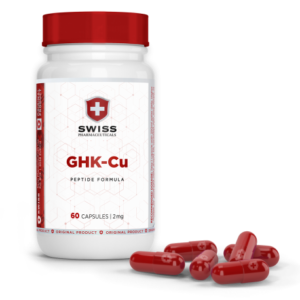
Swiss Pharmaceuticals GHK-Cu 2 mg – 60 Capsules
Swiss Pharmaceuticals GHK-Cu 2 mg – 60 Capsules is listed as 2 mg per capsule in a package of 60 capsules. This is a neutral product-information and regulatory-review draft, not medical advice or proof of authorisation.
The product is reported as 2 mg GHK-Cu per capsule with 60 capsules. GHK-Cu is a naturally occurring copper-binding tripeptide complex. The amount of elemental copper, peptide purity, copper-to-peptide ratio, capsule excipients, stability, and oral bioavailability have not been confirmed for this product.
Reported Product Profile
| Characteristic |
Reported information |
| Active ingredient |
GHK-Cu, the copper complex of glycyl-L-histidyl-L-lysine |
| Strength |
2 mg per capsule |
| Package |
60 capsules |
| Status |
Research and cosmetic peptide complex; oral product claims and authorisation not verified |
What Is GHK-Cu?
GHK is the three-amino-acid peptide glycyl-L-histidyl-L-lysine. It can bind copper ions to form GHK-Cu. The complex has been studied in tissue-remodelling, wound-healing, skin, hair, and gene-expression research. Most consumer familiarity comes from topical cosmetic formulations; evidence for swallowed capsules is much less established.
How It Works
GHK-Cu can act as a copper carrier and signalling complex. Copper is required by enzymes involved in connective-tissue formation, antioxidant defence, and cellular metabolism. Experimental research suggests that GHK-Cu may influence fibroblast activity, collagen and elastin synthesis, glycosaminoglycan production, matrix metalloproteinases and their inhibitors, inflammatory signalling, antioxidant responses, angiogenesis, and expression of genes connected with repair.
A plausible cellular mechanism does not prove that an oral capsule delivers intact GHK-Cu to target tissues. Peptides may be degraded during digestion, copper can dissociate, and absorption depends on formulation. Findings from cell culture, animal models, wound dressings, injections, or topical creams should not be converted into guaranteed claims for skin rejuvenation, hair growth, injury repair, or systemic anti-ageing.
Evidence and Product Limitations
Reviews describe regenerative and protective actions of GHK-Cu, and some controlled cosmetic studies have examined topical applications. The overall evidence base remains heterogeneous, with many mechanistic and preclinical studies. There is no basis for presenting this unverified 2 mg capsule as an approved treatment for wounds, hair loss, inflammation, ageing, or connective-tissue disease.
The certificate of analysis should identify both peptide and copper, specify purity and water content, confirm microbiological quality, and state whether the declared 2 mg represents the complete complex or peptide equivalent. Copper content should be quantified because excessive or inappropriate copper exposure may be clinically relevant.
Safety and Regulatory Considerations
Potential concerns include gastrointestinal upset, hypersensitivity, unknown peptide impurities, copper imbalance, and interactions with conditions affecting copper metabolism. People with Wilson disease or other disorders of copper handling require particular caution. Long-term systemic safety of unverified oral GHK-Cu products has not been established.
GHK-Cu may be encountered in cosmetic research, topical products, compounded preparations, or laboratory materials, but those categories have different legal standards. A capsule promoted for systemic physiological effects may be classified as an unauthorised medicine or novel food depending on the jurisdiction.
Information for Athletes
GHK-Cu is not generally identified as a named prohibited substance, but athletes remain responsible for product contents. The unregulated peptide market presents contamination, substitution, and mislabelling risks.